Looking at data helps get a perspective on the relative importance of phenomena. In particular I wanted to understand what causes EU emissions and data from the European Environment Agency indicate that:
- Total 2021 emissions were 3,600Mtons, down 5% on the previous year
- of which Transportation represents 21% of total
The total emissions for which transportation is liable should therefore be 750Mtons.
If, however, we take the total stock of passenger cars, vans and trucks in Europe (from ACEA), multiply by their average mileage and emissions per km we get a rather different picture:
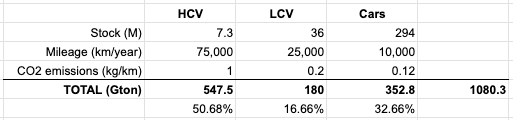
a total which is over 44% higher than the previous value.
Even with this significant uncertainty on the actual value of emissions, it is clear that the electrification of transport would be an enormous step forward in the overall decarbonization path of the EU: an electric vehicle can cut LCA emissions from 50% to 65% (depending on the carbon tenor of electricity in a given country) over the same vehicle with an internal combustion engine but each ICE->EV transition creates a new “Where to charge?” problem.
At the same time, it is obvious that the stakeholders are different: while the vast majority of passenger cars belong to individual consumers vs. businesses, the reverse is true for Light or Heavy Commercial Vehicles yet, at the moment, the only charging solution being deployed is the public charging network.
A puzzle solution
OneWedge believes that there is no silver bullet, i.e. a unique solution that will solve each and every charging problem for professional fleet owners, but rather a mix of solutions, each with its own application scenario, all working in cooperation.
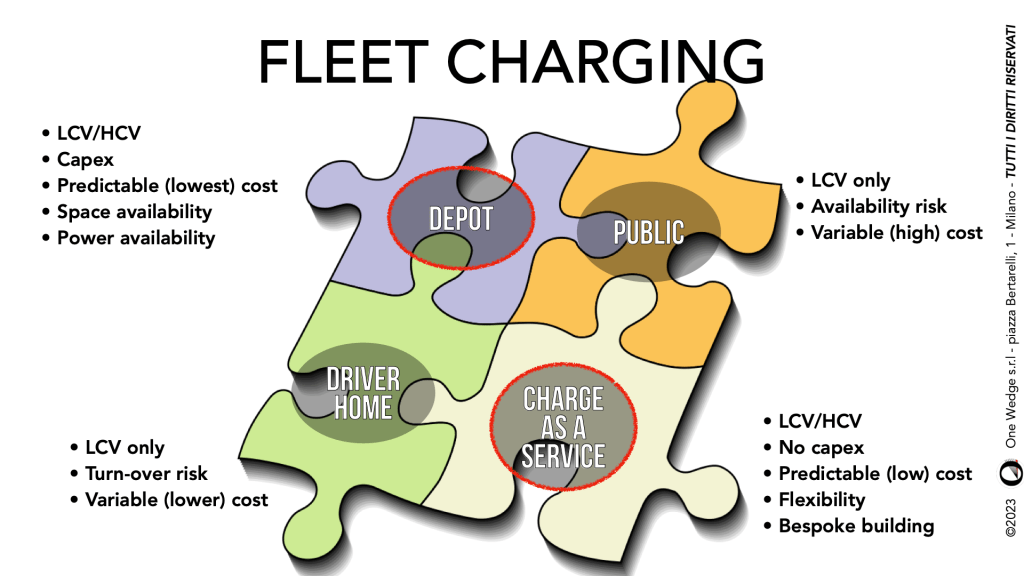
Public charging – it is the most common and readily available solution, reminiscent of the one powering 99% of ICE transportation: you stop by a service station and fill up. However, this might not work for a large swath of the goods transportation market: the service station might not be free when you stop by, it might not powerful enough to charge in a reasonable time the huge batteries of trucks; HCVs are de facto excluded, as charging stalls are almost never large enough to accommodate a tractor+trailer combination; finally, it subjects professional fleet owners to the vagaries of electricity cost and especially now that occupancy rates are low, will always tend to bubble up towards the high end of the price range.
Depot charging – already well under way, it consists of equipping the warehouse parking lots with charging systems. The truck or van stops there for the night and charges, ready to take on the day’s delivery missions in the morning. The applicability of this solution is limited essentially by the available space: a warehouse might be served by as many as 200 vans, but seldom has an idle parking lot for more than 10-20% of those. Ditto for trucks, which of course are even more constrained when it comes to manoeuvering. Another important limitation is the availability of electrical power (most warehouses are not heavy consumers of electricity) whose supply will need to be increased, but this might be easier said than done, at least in some location and entails significant investments.
Another popular solution (of course, for vans only) is to charge the vehicle at the driver’s home, reimbursing the employee for the (small) investment for the wallbox installation and the electricity cost. The main drawback of this solution is that the driver may or may not own a suitable parking spot where to install a wallbox (think of all those who live in apartment buildings, a notoriously thorny problem hindering the EV transition also for consumers) and, should the driver leave the company for whatever reason, the process must be restarted anew with the new employee.
All these are being used in various proportions across Europe, but we believe that there is a fourth solution which complements the previous three, i.e. a dedicated parking lot equipped with charging stations offering to the professional user (not the consumer) parking AND charging services. At OneWedge, we call those plants Electric Plazas and the offer Charge-As-A-Service, and we believe they will play a significant role in the overall puzzle.
The puzzle pieces circled in red are the ones where OneWedge is active.
The advantages of CAAS
- No capex locked into a non-core service
- Client has flexibility should it need to reconfigure its fleet
- Long term service contracts can be signed, locking in fuel costs
- Plazas can be built according to the needs of its clients
- Plazas locations can take into account the proximity of served warehouses, but also local availability e.g. of under-used generation assets
- Capex is shared among Plaza users, ensuring efficient use of capital and competitive charging rates (lower than public charging)
- Occupancy rates are maximised (unlike in the public charging network) ensuring attractive investment returns
- Plazas are extremely granular (critical mass is as little as 20 vans) and can be developed in parallel. Their construction (esp. for LCV) is also extremely fast (<6 months)
- Speed of ramp-up as fast (or as slow) as required by clients
- Cooperative prioritization of development sites
 OneWedge