As some know, OneWedge’s overall mission is to avoid the emission in the atmosphere by 2050 of “One Wedge” (which, in the parlance of the Carbon Mitigation Initiative, is one gigaton of CO2), and we think we can achieve this by enabling the electrification of vehicles.
According to numerous scientific studies (a partial collection is here), an electrified vehicle reduces the emissions associated to its lifecycle by two thirds, so not all vehicles contribute in the same way, and the same billion tons can be achieved with vastly different volumes: in the chart below, each triangle’ area represents 1 billion tons of CO2 not emitted.
So, assuming current EU electricity carbon tenor, it will take the electrification of about 52 million electrified modern cars (grey-blue triangle) to avoid 1 billion tons of CO2, but it would be sufficient to replace 24 millions of the average current car stock (red), or 14 million vans (green) or less than a million heavy trucks (purple).
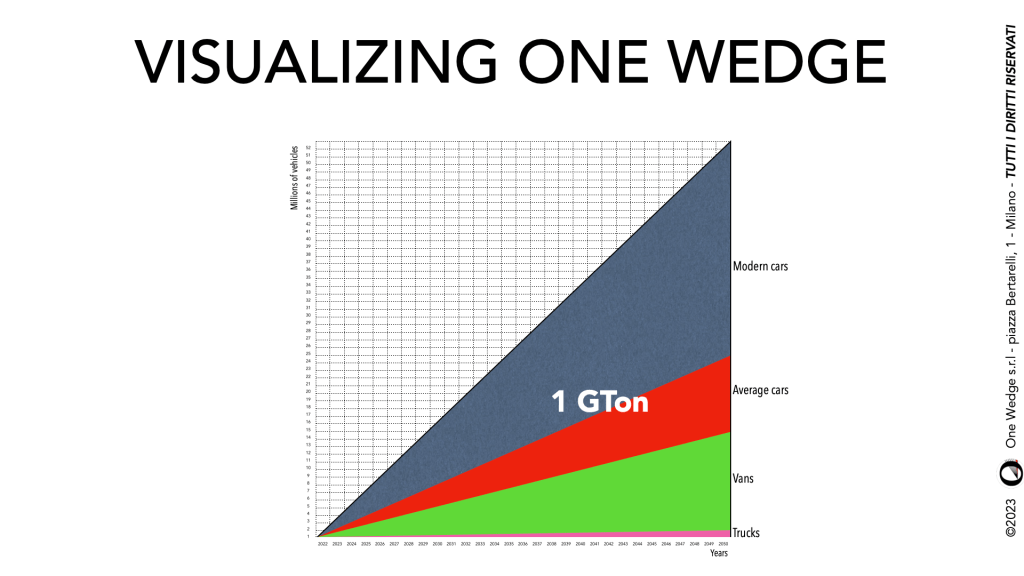
This chart demonstrates therefore very visually why we should concentrate on goods freight to achieve overall emission reduction objectives and it’s also the reason why OneWedge focused its mission here.
Side effect (beneficial)
Freight is also the bearer of an oft-overlooked additional benefit, as not many realize that one of the main commodities being freighted around the world (both in bulk and retail) is… fossil fuels!
Specifically, oil represents a whopping 38% of all maritime shipping cargo:
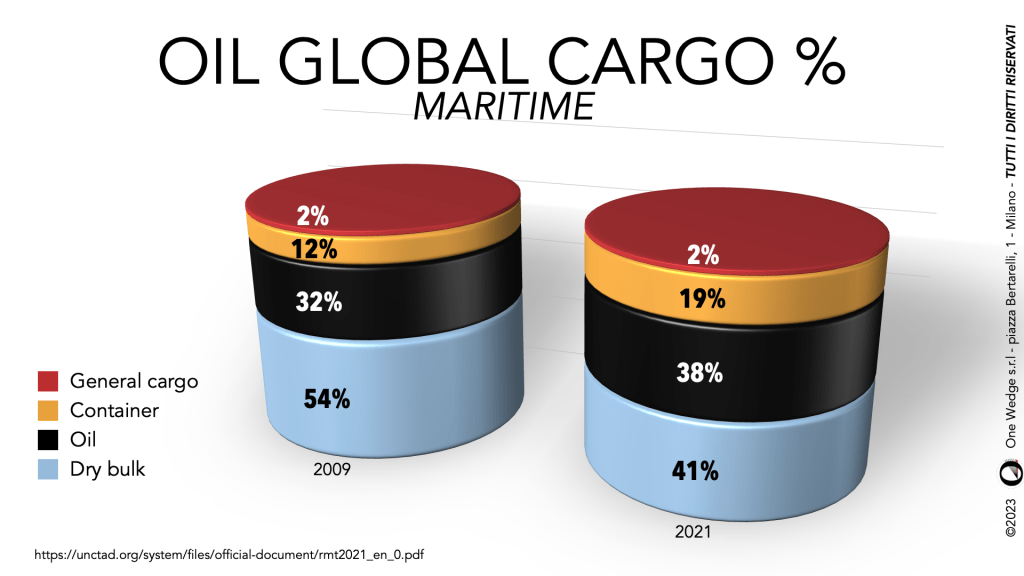
and 35% of all the goods transported by truck:

Since the majority of fossil fuels are used for transportation, the electrification of transportation would eliminate altogether the need for shipping around a good chunk of these fossil fuels in the first place, be it in crude or in refined form, taking off seas and highways a good percentage of the highly polluting trucks and ships we use today.
 OneWedge